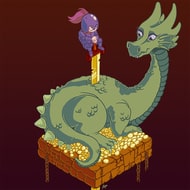
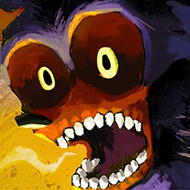
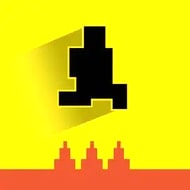
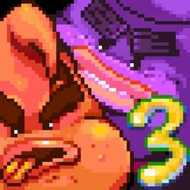
Deepest Sword looks like a scrappy pixel-art platformer about a knight and a dragon, the kind of thing you’d expect to clear in fifteen minutes. It plays like a game actively working against your muscle memory, because the one tool you’re given to move — your own sword — gets longer, heavier, and harder to control every single time you fail.
| Genre |
Physics-based platformer |
| Core mechanic |
Traversal and combat through sword-swing momentum |
| Setting |
A cavern dungeon leading to a dragon’s lair |
| Session length |
Short attempts, replayed repeatedly |
The Sword as Both Weapon and Obstacle in Deepest Sword
The setup is simple on paper: a knight descends into a dungeon to reach a dragon, swinging a sword to clear the way. What makes the game distinct is that the sword isn’t a fixed-length tool. Each time you connect with the dragon, or fall and have to restart a section, the blade grows a little longer, and a longer sword swings with more weight and less predictability.
Early on, the sword is short enough that swinging it feels close to a normal platformer jump. You can tap out quick, controlled arcs to hop small gaps. That control erodes gradually, not suddenly, which is part of why the difficulty curve gets debated in comments sections — some players find the slow creep satisfying, others feel the game quietly punishes them for simply attempting the dragon fight more than once.
Momentum carries over between swings. A common beginner mistake is treating each swing as an isolated action instead of chaining them, which leaves you stranded mid-air with nowhere to redirect. Players who’ve spent real time with the game describe it less as platforming and more as pendulum management.
What New Players Get Wrong Early in Deepest Sword
The instinct to swing hard and often is the fastest way to lose control. A full-strength swing near a ledge will often carry the knight past the intended landing spot entirely, and because there’s no simple jump to correct with, overcommitted swings tend to end in a fall back to an earlier section.
The second common mistake is ignoring wall contact. Wedging the sword against a nearby surface lets you stabilize height in a way that free-swinging in open air doesn’t, and several of the tighter chambers are built specifically around forcing that technique rather than open-air swings.
Sound cues matter more than most newcomers expect. Hazards and hidden enemies are frequently telegraphed audibly before they’re visible on screen, and players who mute the game on their first runs consistently report missing timing windows they’d otherwise catch.
Advanced Techniques Most Players Miss
Once you’re comfortable with basic swings, upward strikes become the more interesting tool. Catching a ledge mid-air with an upward swing lets skilled players skip sections of a chamber entirely, which is exactly how the community’s fastest routes were discovered — not through developer-intended paths, but through players finding creative uses for a mechanic built for something else.
By the time you reach the chamber players nickname Sword 4, the sword is long enough that these skips become genuinely necessary rather than optional flair, since the intended ground-level route gets narrower and less forgiving.
- Chain swings instead of resetting between each one
- Wedge the sword against walls to gain height in tight corridors
- Use upward swings near ledges to catch height mid-air
- Listen for audio cues before committing to a blind swing
The Growing Sword and Difficulty Progression in Deepest Sword
Difficulty here isn’t level-based in the traditional sense — it’s tied directly to how long your sword has become through repeated attempts. A player who clears the dungeon in one clean run faces a fundamentally different game than one who’s died a dozen times and is now dragging a blade nearly as long as the chamber itself.
This is where the design gets genuinely divisive. Some players appreciate that failure has a visible, physical consequence instead of just a respawn timer. Others find it frustrating that struggling with a section actively makes the next section harder, since a longer sword narrows your margin for error right when you’re already having trouble.
The speedrunning community responded to this by formalizing a “no-skip” category alongside open routing, specifically because the lower-path skips some players found made comparing runs meaningless without a separate ruleset.
- Why can’t you just jump over obstacles in Deepest Sword? Movement is built entirely around swing momentum rather than a standard jump button, so clearing gaps means timing an arc with the sword rather than pressing a jump input.
- What happens when the sword gets too long to control in Deepest Sword? A longer blade swings with more weight and less precision, which is why chambers later in the run demand wall-wedging and upward strikes instead of the simple arcs that work early on.
- Is there a way to skip parts of the levels in Deepest Sword? Yes — players have found upward-swing ledge catches that bypass sections of certain chambers, most notably around Sword 4, which led the speedrunning community to split routing into skip and no-skip categories.
What makes Deepest Sword stick with people isn’t the dragon at the end, it’s the specific dread of watching your own sword drag half a second behind your input as you line up a jump near Sword 4. Few browser games turn accumulated failure into a physical, on-screen weapon quite like this one does.