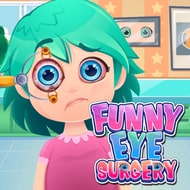
In Funny Eye Surgery you start every shift with a patient already seated and uncomfortable — eyes watering, lids half-shut — waiting for you to decide where to begin. That first decision matters more than it looks, because rushing straight to treatment before cleaning things up properly is how most players lose track of a level.
| Genre |
Medical simulation |
| Platform |
Browser, mobile |
| Players |
Single-player |
| Setting |
Eye clinic |
| Objective |
Diagnose, treat, and style each patient before they leave |
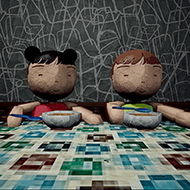
Meeting Luke and Lora in Funny Eye Surgery
The clinic’s two recurring patients, Luke and Lora, each arrive with their own combination of ailments, and the game expects you to read what’s actually wrong before reaching for a tool. A patient with watery eyes and visible gunk needs a different opening step than one who’s squinting at the eye chart from the moment they sit down.
New players often click through the intro screen without really looking at the patient, then wonder why later steps don’t register properly. Funny Eye Surgery is built around observation first, tool second — skipping that order tends to produce sloppy, unsatisfying results even when you technically finish the level.
Luke and Lora aren’t interchangeable either. Their reactions differ slightly depending on how gently or roughly you handle each step, which is part of what keeps repeat sessions from feeling identical.
Cleaning Up Before Any Real Treatment
- Pull the eyelids apart gently to get a clear look at what’s actually going on underneath
- Apply eyedrops to loosen debris and soothe irritation before touching anything else
- Use the napkin to clear away tears so your view stays clean
- Work the ear-pick carefully to remove stubborn gunk without over-poking
- Extract any visible foreign objects, bugs, or small toys lodged in the eye
Skipping steps in this sequence doesn’t just look messy — it actively slows down the diagnostic stage that follows, since a dirty eye hides the details you need to treat it correctly.
The Vision Test and Reading the Color Chart
Once the eye is clean, Funny Eye Surgery moves into diagnosis: identifying which colored number the patient can actually see and matching it against the chart. It’s a small puzzle disguised as a medical step, and it’s the moment where the game quietly checks whether you were paying attention during cleanup.
Players who like the more methodical, puzzle-adjacent side of simulation games tend to single this section out as their favorite part of each level, since it’s the closest the game gets to an actual test of attention rather than pure clicking.
Treating Cataracts Without Flinching
Cataract cases raise the stakes slightly — an incision followed by a corrective shot replaces the simpler cleaning-and-lens routine used for milder cases. It’s still cartoonish rather than graphic, but it’s the one procedure that consistently gets brought up by players describing the game as more involved than its silly tone suggests.
Getting the incision step wrong doesn’t usually fail the level outright, but it does produce a noticeably worse reaction from the patient, which is enough feedback for most players to slow down and get it right on a second attempt.
Picking Glasses, Hats, and Stickers
Once the medical work is done, Funny Eye Surgery hands you a wardrobe of glasses, hats, and stickers to dress up Luke or Lora before they leave the chair. This stage has no real fail state, so it functions as a reward lap rather than another challenge to clear.
By the time you reach the styling stage a few times, you’ll start recognizing which accessory combinations trigger the more exaggerated happy reactions — a small detail, but one players screenshot and share more than any of the treatment steps.
What Makes Funny Eye Surgery Satisfying to Replay
The loop of clean, diagnose, treat, style stays short enough per patient that replaying levels doesn’t feel repetitive so much as habitual, and later levels introduce new complications inside that same structure rather than throwing out the formula entirely.
Common Mistakes New Players Make in Funny Eye Surgery
The most frequent slip-up is jumping straight to the vision test before fully clearing debris, which muddies the diagnosis and makes the following steps harder than they need to be. The second is rushing the cataract incision instead of taking the extra second to line it up properly.
How do you clean the eyes in Funny Eye Surgery?
Eyedrops loosen debris first, then the napkin clears tears and the ear-pick removes stubborn gunk before you extract any visible foreign objects — doing these in order keeps the eye clear enough for an accurate diagnosis afterward.
What tools are used in Funny Eye Surgery?
The core toolkit includes eyedrops, a napkin, an ear-pick for cleaning, extraction tools for debris, an eye chart for vision testing, and an incision tool paired with a corrective shot for cataract cases, followed by a styling set of glasses, hats, and stickers.
Can you customize how patients look in Funny Eye Surgery?
Yes — after treatment, both Luke and Lora can be dressed up with a range of glasses, hats, and stickers, and this stage has no fail condition, so it’s purely a chance to give each patient a look before they head out the clinic door.
Funny Eye Surgery earns its replay value from that small, satisfying rhythm — eyedrops, napkin, ear-pick, chart, then whatever ridiculous glasses Luke ends up wearing on his way out the door. It’s a silly premise carrying a surprisingly structured little procedure underneath.