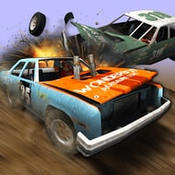
Demolition Derby Crash Racing looks like a throwaway browser racer — cartoonish muscle cars, a simple arena, a nitro key you mash without thinking. It plays like something closer to a war of attrition, where the driver who manages armor and positioning outlasts the driver who just floors it into the nearest opponent.
| Genre |
Vehicular combat, arcade racing |
| Platform |
Browser |
| Players |
Single-player and multiplayer |
| Setting |
Closed demolition arena |
| Objective |
Destroy or outlast rival cars |
The Garage: Where Demolition Derby Crash Racing Really Starts
Before any arena run, the garage is where the game actually gets decided. You buy new muscle cars or pour earned cash into upgrading engine output, armor plating, and braking on the one you already own. Skipping the garage to jump straight into a match is the single most common mistake new players make, since a stock car gets outmuscled fast once opponents start stacking upgrades of their own.
Among the roster, one car in particular — nicknamed Smash by the community for its outsized armor and health pool — gets singled out constantly in player discussion as the pick for anyone prioritizing survivability over speed. It’s not subtle, and it’s not meant to be; it’s a tank on wheels, and it plays like one.
Currency earned from races funds every upgrade path, so early runs tend to be about grinding just enough cash to push one stat — usually armor — ahead of where a stock car starts.
Arena Survival and What It Actually Tests
Arena Survival puts you in with a field of opponents and narrows the field down until one car is left rolling. It’s the mode most players associate with the game’s identity, and it rewards patience more than aggression — charging into the first crash you see usually means you’re the wreck someone else earns points for.
Positioning around the edges of the arena, letting two opponents collide with each other before you commit, is a habit that separates players who consistently place well from players who burn through cars every run.
Defensive-minded players tend to favor Arena Survival specifically because it punishes reckless driving harder than the other modes do.
Endless Mode and Chasing a High Score
Endless Mode strips away the win condition entirely and asks a simpler question: how long can you last? Cash earned here still feeds back into garage upgrades, which makes it a favorite among players grinding toward a fully upgraded car rather than chasing a single strong finish.
The mode rewards a different mindset than Arena Survival — instead of hunting for a finishing blow, you’re managing wear over a long stretch, which means brake upgrades matter more here than in shorter, more chaotic modes.
Tournament Racing and Time Trials
Tournament Racing structures events with escalating difficulty, meaning the garage upgrades you skipped early tend to catch up with you here first — later tournament rounds assume you’ve already invested in your car rather than treating every match as a fresh start.
Time Trials strip out opponents almost entirely and turn the arena into a race against the clock, which is where players who mainly care about nitro timing and clean cornering tend to spend most of their practice time.
Nitro, Drifting, and the Physics Underneath the Chaos
Controls stay simple on purpose — WASD to drive, Spacebar to trigger nitro — but the crash physics underneath reward more precision than the controls suggest. Nitro timing: using a boost to close distance right before impact adds meaningfully more force to a collision than the same boost used just for straight-line speed, which is a distinction new players rarely notice until they’ve been on the receiving end of it.
Once you’ve logged enough runs to feel the difference between a glancing hit and a square one, drifting around the arena’s edges to line up a full-force collision stops being a flashy move and starts being the actual strategy.
What Players Debate About Demolition Derby Crash Racing
The most common complaint in community discussion is the currency grind — early cash rewards feel slow relative to how quickly a stock car falls behind upgraded opponents, and some players find the first several runs frustrating before the garage catches up. It’s a fair criticism, and it’s part of why players searching for shortcuts often look for cheats or unlock codes, even though the game has no official ones; progress is meant to come from winning events, not from bypassing the grind.
Some players also point out that multiple tracks and events unlock gradually rather than being available from the start, which shapes early sessions around a smaller pool of arenas than the game eventually offers.
None of that undercuts what Demolition Derby Crash Racing is actually good at: the moment a nitro-timed hit sends an opponent’s car spinning off the arena floor, or when your fully upgraded Smash shrugs off a collision that would have wrecked a stock car outright. That’s the payoff the garage grind is building toward the whole time.