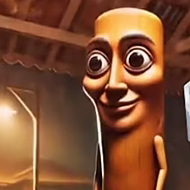
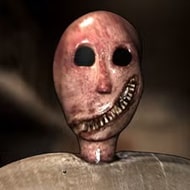
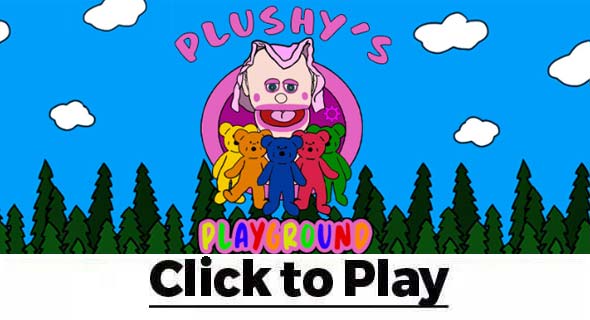
You step into Plushy’s Playground with Plushy already mid-movement, sliding across a stitched foam floor as the first set of moving toy blocks starts shifting under your feet and the soft hum of the mechanical carousel echoes through Softwood Park, creating a sense that the space is already in motion before you even gain control.
Movement and Spatial Control in Plushy’s Playground
The entire structure of Plushy’s Playground revolves around controlled momentum, where Plushy’s stitched limbs respond with slight delay, making precision feel intentionally soft rather than sharp. Early sections in Softwood Park teach you how sliding affects jump arcs, and players often underestimate how much drift carries into landing zones, especially on rotating foam discs that subtly shift mid-air alignment.
By the time you reach the Button Bloom Bridges, movement becomes less about speed and more about rhythm recognition, since each platform cycle is tied to hidden timing loops. Players who rush often fall into Thread Snag traps placed between floating cushions, where overcorrection leads to chain misalignment and forced resets.
One detail many players remember is the faint fabric stretching sound when Plushy overextends a jump, which acts as an unspoken warning before a failed landing. This sound cue becomes essential later in Softwood Park corridors where visual clarity is reduced by overlapping stitched effects.
Movement also subtly changes depending on surface density, meaning foam tiles behave differently from yarn-wrapped platforms. Players who rely only on directional input without reading surface behavior often struggle during mid-game transitions.
Thread Snag Behavior Patterns in Plushy’s Playground
Thread Snags appear as tangled yarn clusters that react to proximity rather than direct collision, which surprises first-time players expecting static hazards. These entities tighten nearby platforms, altering geometry mid-jump and forcing mid-air correction that often feels unfair until their radius logic is understood.
This mechanic is one of the most debated systems because it feels inconsistent until you learn its hidden activation layering, especially in overlapping zones where multiple Snags interact. Puzzle-focused players enjoy decoding it, while speed-focused players often call it unpredictable during Softwood Park traversal.
The tension spikes when multiple Snags overlap near rotating platforms in Softwood Park’s mid-loop section, where even small timing errors cascade into full section resets. In these moments, Plushy’s stitched momentum becomes harder to predict, increasing reliance on learned rhythm rather than reaction.
Advanced players often intentionally bait Thread Snags into tightening early, creating predictable gaps in later cycles. This strategy is risky but widely used in community discussions under the term “pre-tight routing.”
Softwood Park Progression Flow in Plushy’s Playground
Softwood Park acts as a layered teaching zone with progressively complex traversal challenges that slowly introduce stitched mechanics. You begin with static platforms and gradually encounter rotating yarn wheels, collapsing plush tiles, and shifting seam bridges that reconfigure while you are mid-jump.
The transition into deeper zones feels natural, but the difficulty curve sharpens once Ink Drips begin altering surfaces in real time. These changes force players to rethink previously learned movement timing because safe paths can dissolve without warning.
Casual players often stop here due to the sudden complexity spike, while exploration-focused players continue to uncover hidden stitch tunnels behind rotating structures. These tunnels are often marked only by faint seam discoloration that blends into background textures.
By late Softwood Park progression, platform cycles overlap so heavily that players begin memorizing sound patterns instead of visuals, a shift that defines mastery in Plushy’s Playground.
Advanced Stitch Techniques in Plushy’s Playground
Advanced players use a technique known in community discussions as “thread slipping,” where Plushy’s delayed landing is used to bypass intended platform cycles. This is not explained in-game but discovered through repeated failure loops in Softwood Park’s rotating corridors.
Another tactic involves baiting Thread Snags into tightening specific bridges, creating temporary shortcuts that disappear after one cycle. It is risky but widely used in high-skill runs where speed routing matters more than safety.
The most skilled players combine both methods during Softwood Park’s final rotation loop, chaining momentum drift with pre-tight Snag behavior to skip entire puzzle segments. This requires precise timing within half-second windows.
Some players argue this breaks intended pacing, while others see it as the natural evolution of Plushy’s Playground mastery systems.
Why do Thread Snags react differently in dense zones?
Thread Snags in Plushy’s Playground respond to overlapping proximity fields, especially in areas like Softwood Park’s rotating hub. When multiple Snags activate together, their tension zones merge and distort platform stability, making movement less predictable than isolated encounters. This is why dense areas feel more chaotic even when mechanics remain identical.
What causes Plushy to slip on certain stitched surfaces?
Slipping occurs when Plushy’s momentum exceeds surface grip thresholds on stitched foam tiles, particularly during angled landings. In Plushy’s Playground, these thresholds vary by zone material density, especially near Button Bloom Bridges where rotation affects grip alignment. Players often mistake this for input delay rather than physics behavior.
How do hidden stitch tunnels affect progression?
Hidden stitch tunnels in Plushy’s Playground bypass major puzzle segments in Softwood Park by connecting non-adjacent zones. They are usually activated by aligning Plushy with faint seam patterns in walls that only appear under specific lighting angles. These routes reward exploration-focused players with faster progression paths and alternate puzzle sequences.
Plushy’s Playground ends its early arc inside Softwood Park where Plushy finally unlocks controlled stitch anchoring, a mechanic that reshapes how players approach Ink Drip zones, Thread Snag encounters, and the shifting rhythm of Button Bloom Bridges as movement becomes fully intentional rather than reactive.