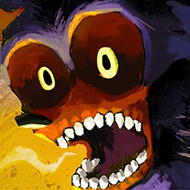
What actually happens after the third mistake in a shift at Happy’s Humble Burger Farm? Burn the meat, leave a drink unfilled too long, or take too long plating an order, and the answer isn’t a game-over screen — it’s the mascots’ eyes going white.
| Genre |
Restaurant sim / survival horror |
| Setting |
New Elysian City |
| Structure |
Repeating day-night cycle, roughly 4–5 hour campaign |
| Core Loop |
Cook and serve, then explore between shifts |
Clocking In at Happy’s Humble Burger Farm
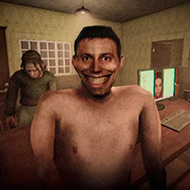
The day-to-day loop in Happy’s Humble Burger Farm is deceptively simple: wake up, go to work, cook whatever the customer at the counter is asking for — grilled meat, a filled drink, a heated cookie or pie — and get it out before the shift’s tension ramps up. Early shifts feel almost like a straightforward cooking game, and that’s intentional. The unease builds gradually rather than announcing itself.
As the days progress, appliances start failing at random, lights flicker off mid-order, and shapes begin moving at the edge of the kitchen that will startle you if you get too close. None of this happens on a fixed schedule, which means no two shifts play out quite the same way, even once you’ve learned the cooking mechanics cold.
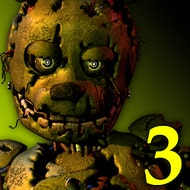
Players who came in expecting a straight cooking sim tend to be surprised by how much survival-horror tension gets layered onto that base. Others, who came in through the Five Nights at Freddy’s-adjacent mascot-horror crowd, are usually surprised by how solid the actual food-prep mechanics are underneath the scares.
Ryder Heitzman and the Truth Behind New Elysian City
The player character isn’t just a random hire — he’s Ryder Heitzman, a reporter whose memory and identity were wiped to stop him from exposing what a figure named Grimm had been doing on Durri-Jongo Island. That backstory only surfaces gradually, through exploration rather than cutscenes, which is part of why the mystery around Happy’s Humble Burger Farm holds up as its strongest feature.
New Elysian City itself turns out to be far stranger than it first appears, an elaborate underground replica sustained by a compliance chip implanted in the skulls of the people trapped inside it. As Ryder starts to interfere with that chip, the city’s illusions begin to erode, revealing plain wooden sets behind what looked like real buildings moments earlier.
A disembodied robotic head named Vic becomes an unlikely ally partway through, offering hints, exposition, and information about the company behind the Lucidus Initiative — the project at the center of everything happening to Ryder and the Barnyard Buds. Vic’s own backstory, that of a hidden creator, adds another layer to a plot that rewards players who explore fully rather than rushing shifts.
The Barnyard Buds’ Three-Strike Rule
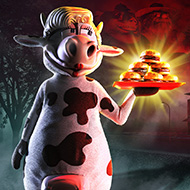
The core threat mechanic is straightforward once you understand it: the Barnyard Buds — Happy the Humble Heifer, Petey the Portly Pig, Charlie the Chillin’ Chicken, and Sammy the Surly Salmon among them — stay friendly right up until you make three mistakes during a shift. Cross that line and they turn hostile, actively hunting the player through the restaurant.
Happy herself behaves like a statue-horror threat, freezing in place whenever she’s being directly looked at and only advancing the moment your eyes leave her. Players quickly adopt shorthand for this in forums, describing it as a “don’t blink” mechanic borrowed loosely from that genre convention, even though Happy’s Humble Burger Farm builds its own identity around it.
Not every mascot dies the same way. Charlie, the most animalistic of the group, needs to be lured into an incinerator to be permanently dealt with, while feeding a rotten patty burger to certain hostile Assets causes them to disappear outright. Learning which mascot responds to which method is one of the more satisfying discoveries new players make on their own.
Exploring the Jazzy Java Joint and Beyond
Between shifts, Happy’s Humble Burger Farm opens up New Elysian City for free exploration, letting players wander into locations like the Jazzy Java Joint, Quick Qure, Steal ‘n’ Sell, and the New Elysian Museum. None of these stops are mandatory in a strict sense, but skipping them means missing tools that unlock further areas back at the restaurant.
The pacing here is unusually player-driven. If exploration stalls out, simply returning home to sleep advances to the next shift and keeps the story moving, which means players can push forward at whatever pace suits them rather than being funneled through fixed story beats.
Lore hunters in particular gravitate toward this exploration phase, since scattered details about Grimm, the Lucidus Initiative, and the fate of the original Burger Barn location are tucked into environmental details rather than spelled out directly.
What New Employees Get Wrong at the Farm
The most common early mistake is treating cooking mistakes as purely mechanical failures with no consequence beyond a bad review. In reality, every slip counts toward the three-strike threshold that turns the Barnyard Buds hostile, so a string of small errors early in a shift can leave almost no margin for error later on.
New players also tend to underuse the tools they unlock through city exploration, sticking to whatever equipment they started with. That’s a mistake, since several of those unlocked tools double as combat options during the game’s more intense boss-style encounters.
Panicking once a mascot turns hostile is another common misstep. Each Bud has a specific weakness or ritual tied to it, and reacting on instinct rather than recalling what that particular mascot responds to usually ends a shift early.
Facing Asset Farmer and the Lucidus Initiative’s Endgame
The scythe-wielding Asset Farmer serves as the game’s final confrontation, tying back to the original Burger Barn location where the entire mascot-horror concept began. By the time you reach this fight, the cooking mechanic itself has doubled as a combat tool for several encounters, and Farmer’s fight leans hardest into that idea.
Some players find the shift from cooking-sim tension to full boss-battle spectacle a satisfying payoff; others feel it leans a little too hard into familiar mascot-horror beats without fully escaping the shadow of the games that inspired it. Both reactions show up regularly in community discussion, and it’s a fair critique either way.
What’s harder to dispute is how much narrative groundwork pays off by this point — Vic’s parting words, Ryder’s fractured memory, and the slow unraveling of New Elysian City all converge in a way that rewards players who explored rather than rushed.
- How do you deal with a mascot after it turns hostile in Happy’s Humble Burger Farm? It depends on the specific Bud — Happy freezes when watched and must be avoided rather than confronted directly, Charlie needs to be lured into an incinerator, and certain hostile Assets can be removed by feeding them a rotten patty burger instead of a fresh one.
- What triggers the three-strike system? Cooking errors during a shift — burning meat, leaving a drink unfilled too long, or delaying an order — count toward three strikes, after which the Barnyard Buds stop behaving normally and start actively hunting the player.
- Is Happy’s Humble Burger Farm connected to Burger Barn? Yes, it’s a direct continuation of Happy’s Humble Burger Barn, with the story and mascot cast carrying forward into New Elysian City and the events tied to Grimm and the Lucidus Initiative.
Between Ryder’s buried past, Vic’s quiet hints, and Happy’s unblinking stare from across the kitchen, Happy’s Humble Burger Farm turns a night shift into something far stranger than food service was ever supposed to be.