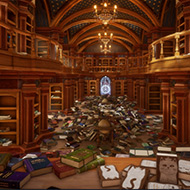
In Librarian: Tidy Up the Arcane Library you start with 3,072 books scattered across a ruined archive and exactly zero magic to help you sort them, which matters more than it sounds like it should.
| Genre |
Organization Simulation, Puzzle |
| Perspective |
First person |
| Full Completion |
3,072 books across 400 rows |
| Core Abilities |
Assemble, Insight, Auto-Shelving |
Sorting the Chaos in Librarian: Tidy Up the Arcane Library
The premise is deceptively small: a mischievous fairy has thrown the once-majestic archive into disarray, and you’re ordered to restore every volume before you’re allowed to leave. From there, Librarian: Tidy Up the Arcane Library hands you a first-person view of a genuinely massive collection and lets the scale of the mess do most of the early intimidation on its own.
Every book carries visual and textual clues — title, cover design, series markers — that determine which shelf it belongs on, and the game rewards players who read those clues carefully over players who just grab and place. A shelf only lights up blue once every book on it is correctly grouped by series and ordered by volume number from left to right, which means a single misplaced or out-of-sequence book can leave an otherwise “finished” row sitting dark.
Beginners almost universally make the same early mistake: clearing piles randomly instead of picking one recognizable series, gathering every volume of it, and placing the whole set correctly before moving to the next. Random clearing feels faster in the first few minutes, but it tends to scatter partial series across multiple shelves, creating exactly the kind of split-series problem that later becomes hardest to untangle.
Full completion requires clearing all 400 rows across the library, and that number alone tells you how much this game leans on sustained, patient sorting rather than short bursts of activity — a pace some players find meditative and others find genuinely exhausting by the later floors.
Assemble, Insight, and the Principal’s Evaluation
As rows get completed, the game gradually unlocks abilities that reshape how sorting works. Insight highlights other volumes belonging to the same series, making them easier to spot even scattered across a disorganized pile, while Assemble goes a step further and summons every other volume of a matched series directly to your hands. Auto-Shelving rounds out the set by instantly placing whatever books you’re currently holding onto their correct shelves.
Once Assemble and Insight are both unlocked, the entire rhythm of the game shifts — what started as a hands-on hidden object hunt becomes more about efficiently chaining ability uses, and several players note this is the point where individual books stop feeling special and the run starts feeling like pure optimization instead.
Throughout all of this, the Principal’s evaluation runs in the background, shifting in real time based on how many rows are correctly shelved according to the rules. Accuracy and speed both factor into that score, and players chasing a strong evaluation quickly learn that a fast but sloppy pass through the library actively works against them.
Four hidden keys exist across the library — Crimson Octagon, Golden Diamond, Azure Star, and Emerald Club — each unlocking a different upgrade like sprint speed, a higher jump, or extra carrying capacity. Community guides consistently recommend grabbing Crimson Octagon first, since the mobility boost it unlocks makes navigating the rest of the archive noticeably faster.
Reading the Shelf Maps as the Library Fills In
Once shelves start turning blue in bulk, the ambient sound and background music shift too — the acoustic resonance of the library grows stronger as more of it gets restored, which is a detail players frequently mention as the moment the whole space starts feeling less like a chore and more like an actual accomplishment.
By the time a player reaches the later shelf sections, the categories on offer widen considerably — fantasy and magic dominate the first floor, while the second floor shifts into daily life, social topics, fiction, history, and otherworld travel, which forces a mental map adjustment for anyone who’d gotten comfortable with the earlier, narrower sorting logic.
One persistent frustration shows up often enough in community discussion to count as a known issue: a row sitting at 399 out of 400 books with no obvious error, usually traced back to a volume order mistake or a book quietly split into a neighboring row rather than anything actually missing.
- How many books are in the full Librarian library? The complete collection totals 3,072 books spread across 400 rows, and reaching full completion means every one of those rows needs to be correctly shelved by series and volume order.
- What do the Assemble and Insight abilities actually do? Insight highlights other volumes from the same series to make them easier to spot in a pile, while Assemble goes further and summons every matching volume directly to your hands, both unlocked as rows are completed.
- Why won’t a shelf turn blue even though the books look correct? A dark indicator almost always means a volume order mistake or a series split across neighboring rows — the game requires books grouped by series and ordered by volume left to right, and a single book out of place is enough to keep the shelf from lighting up.
Some players have pushed back specifically on the game’s use of AI-generated art for a handful of interface elements and background paintings, a criticism that comes up regularly enough in reviews to count as one of the more debated aspects of an otherwise well-liked release. Whatever side of that debate a player lands on, Librarian: Tidy Up the Arcane Library still comes down to the same quiet satisfaction — watching a dark shelf finally turn blue once Emerald Club and the last stray volume of a series click into place.