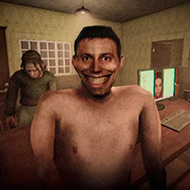
You start the round already moving in Nextbot Graveyard, because the moment the timer begins, whatever’s chasing you is already closing distance — there’s no grace period, no slow buildup, just a hundred seconds and a pursuer that doesn’t stop.
| Genre |
First-person survival chase |
| Structure |
Six escalating stages, 100 seconds each |
| Controls |
WASD movement, mouse interaction |
Surviving 100 Seconds in Nextbot Graveyard
The build behind this listing runs as Nextbot: Can You Escape? — a straightforward survival-chase game where the objective per stage is simple on paper: last a hundred seconds against a relentless pursuer that constantly closes the gap toward your position. There’s no combat option and no way to disable the threat outright; the entire loop is movement, spatial awareness, and figuring out each stage’s layout well enough to keep distance without running into a dead end.
Six stages make up a full run, and each one raises the pressure over the last — tighter corridors, fewer safe loops to circle, and a pursuer that feels like it’s closing distance faster even when the underlying speed hasn’t actually changed.
Reading a Stage Before You Need To
Early stages give you room to learn dead ends and loops without serious consequence, since the pursuer’s starting distance is generous enough to allow some exploration. That changes fast — by the later stages, wasted movement toward an unfamiliar dead end is often enough to end the run outright, since there’s no time buffer left to recover from a wrong turn.
Players who treat every stage identically tend to struggle once the later, tighter layouts show up. Learning each stage’s loop options before committing to a direction is the actual skill separating clean hundred-second clears from repeated early losses.
What Beginners Get Wrong Chasing a Clean Run
- Running in a straight line instead of using corners and loops to break line of sight
- Panicking and reversing direction mid-chase, which usually costs more distance than it recovers
- Treating all six stages as equally forgiving, when later stages punish hesitation far more severely
How Nextbot Graveyard’s Later Stages Change the Math
By the time you reach the final couple of stages in Nextbot Graveyard, the margin for error has shrunk to almost nothing. A single wrong turn into a dead end is often fatal, which is exactly why players treat a full six-stage clear as a genuine achievement rather than a formality.
- Does the pursuer actually speed up each stage? The perceived speed increase comes mostly from tighter layouts leaving less room to create distance, more than a straightforward speed boost.
- Is there a way to permanently lose the pursuer? No — the goal each stage is surviving the full 100 seconds, not eliminating or evading the threat indefinitely.
Nextbot Graveyard doesn’t ask for much beyond a hundred seconds of full attention per stage, but between corners that don’t loop the way you’d expect and a pursuer that never actually stops, that hundred seconds rarely feels short.