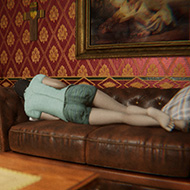
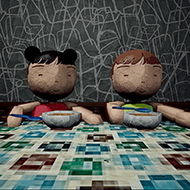
What happens the moment a knock lands on your door after midnight and you genuinely can’t tell if the voice outside belongs to a person or something wearing one? No, I’m not a Human builds its entire game around that single unanswerable question, asked over and over until you stop trusting your own judgment.
| Genre |
Psychological Horror, Survival |
| Setting |
A single house during a post-apocalyptic crisis |
| Perspective |
First person, interrogation-based |
| Core Loop |
Nightly visits from Guests and Visitors |
Guests, Visitors, and the Core Loop of No, I’m not a Human
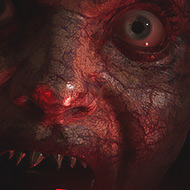
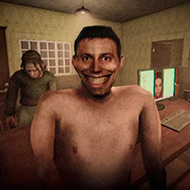
Every night in No, I’m not a Human plays out the same basic shape: someone knocks, you decide whether to open the door, and if you do, an interrogation begins. The people who arrive are always called Guests until proven otherwise — some are exactly what they claim to be, seeking shelter from the ruined world outside, and some are Visitors, beings that mimic humans closely enough to pass a casual glance, right down to small mannerisms that only slip under sustained questioning.
The interrogation system is where the actual game lives. You’re not fighting anything with your hands — you’re listening for inconsistencies, watching for behavior that doesn’t quite track with what a real survivor would do or say after weeks of scorched streets and dwindling supplies. A Guest who flinches at the wrong moment, or answers a question a beat too smoothly, becomes suspect, and once that suspicion sets in, every following answer gets weighed against it.
Beginners tend to make one of two mistakes. Either they let almost everyone in out of caution against turning away a real survivor, which overwhelms the house fast, or they turn away anyone who seems slightly off, which racks up a different kind of loss when a genuine human dies outside your door. Neither instinct alone gets you through a full run, and the game seems built specifically to punish whichever extreme a player settles into early.
By the third or fourth knock of a given night, the interrogation options themselves start feeling less like a script and more like a genuine conversation, since the Guest’s answers begin referencing details from earlier exchanges — a consistency check that catches players who’ve stopped paying close attention after a few “easy” reads in a row.
Reading Tells Without Overcorrecting in No, I’m not a Human
The game doesn’t hand you a checklist of Visitor traits, and that’s deliberate. What passes as a “tell” shifts slightly from encounter to encounter, so players who memorize a single rule — like distrusting anyone who avoids eye contact — get burned once the game varies the pattern on a later night. The interrogation rewards attention over memorization, which is a distinction the community brings up constantly when newer players ask for a foolproof method.
Players who lean into every conversation, dragging out interrogations to squeeze out more detail, tend to catch inconsistencies that faster players miss entirely, since a Visitor’s mimicry tends to crack only after the third or fourth follow-up question rather than the first. Players who prioritize keeping the house population up move quicker through each Guest, accepting more risk in exchange for more bodies behind locked doors come daylight, which becomes its own resource-management trade-off once the house starts running low on supplies.
Sound plays a bigger role than most first-time players expect. A Visitor’s voice can carry a flatness that’s easy to miss with headphones off, and by the time a player reaches their third or fourth night, that vocal cue often becomes more reliable than anything said in dialogue. Players in community threads frequently describe this as “the flatness” once they’ve learned to listen for it, treating it almost like a tell of its own separate from anything a Guest actually says.
One detail rarely mentioned outside dedicated discussion threads: a Guest’s willingness to answer a question about a specific, mundane pre-apocalypse memory tends to be more revealing than any dramatic question about the Visitors themselves, since fabricated answers to small, boring details are harder to improvise convincingly than answers to the big, expected questions.
Branching Outcomes as No, I’m not a Human Progresses
Every accepted or rejected Guest nudges the story rather than resetting it, which is why two players rarely describe the same run. Let in a Visitor by mistake early on, and later nights start referencing consequences from that choice — a smaller house, a different set of Guests arriving, dialogue that acknowledges who’s missing, sometimes delivered by a Guest who knew the person you turned away.
Difficulty in No, I’m not a Human isn’t tuned through tougher enemies, it’s tuned through ambiguity. Later nights offer thinner evidence and higher stakes attached to getting it wrong, and the game leans on that discomfort rather than escalating combat or numbers. By the time the house is down to its last few occupants, even a confident read on a Guest starts to feel like a guess dressed up as certainty.
One detail players consistently bring up in discussion threads is how a Visitor’s dialogue can sound almost too polished, a kind of over-explaining that only stands out once you’ve sat through several nights of the real, messier way actual survivors talk about the collapse outside. Community vocabulary has settled on calling this “over-selling it,” and spotting it becomes one of the more reliable tells once a player has heard enough genuine Guests stumble over their own memories by comparison.
Roughly a handful of distinct endings are reachable depending on how the nights accumulate, which is enough variation that players routinely compare final-night screenshots to figure out which choices actually diverged their run from someone else’s.
- How do you actually tell Visitors apart from real humans? There’s no single reliable sign — the game varies flinches, vocal flatness, and inconsistent answers to daily-life questions across different Guests, so players end up cross-referencing multiple small cues, including the “flatness” in a Visitor’s voice and how smoothly they answer mundane pre-apocalypse questions, rather than relying on one fixed rule.
- How many endings does No, I’m not a Human have? The ending you reach depends on the pattern of choices made across every night rather than one final decision, with outcomes shifting based on how many Guests were let in versus turned away, how many of those turned out to be Visitors, and which specific Guests survived to reference later nights.
- Is No, I’m not a Human connected to a specific real event or story? No — it’s framed as a fictional apocalypse scenario rather than a dramatization of a documented case, built around the mimicry premise and the Visitors themselves rather than any single true account.
By the last few nights of No, I’m not a Human, most players stop trusting the interrogation checklist entirely and start relying on gut instinct built from every prior Guest they got wrong, which is really the whole game working exactly as intended — right down to the moment a familiar voice knocks again and you have to decide whether that “flatness” was ever really there.