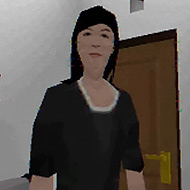
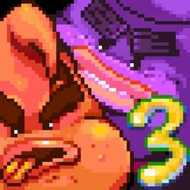
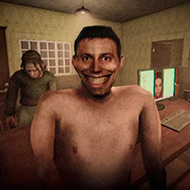
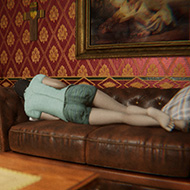
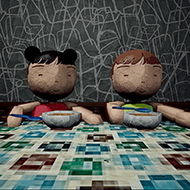
What happens when a single decision, made in one weak moment, is the only choice in the entire game that actually matters? Pikabuu: STOP builds its whole narrative around that question, following Beni through the aftermath of one gamble he can’t take back.
| Genre |
Visual Novel, Psychological Horror |
| Perspective |
First person, narrative-driven |
| Endings |
Six total — two good, four bad |
| Languages |
Available in six languages |
Beni’s Family and the Premise of Pikabuu: STOP
The story centers on Beni, a devoted husband to Nadia and father to Kaila, whose family has always gotten by on simple contentment rather than any real financial cushion. Pikabuu: STOP opens with that stability intact, which makes the unraveling that follows land harder than if the game had started somewhere already in crisis.
Unlike most horror games, there’s almost no traditional gameplay for most of the runtime — no combat, no exploration, no puzzles to solve. The game leans entirely on narrative pacing and a handful of pivotal choices to carry its weight, which means players expecting mechanical depth are often surprised by how much the tension comes purely from what Beni is about to do next rather than anything the player is actively controlling.
The one genuinely pivotal choice arrives early: whether Beni accepts an offer that promises to solve the family’s money troubles fast. Reject it, and the game moves toward one of its two good endings relatively directly. Accept it, and Pikabuu: STOP shifts into something closer to a slow-motion account of a decision compounding on itself.
Limited Choices and the Weight of One Bad Decision
Once Beni accepts the offer, players notice something the community has openly debated: interactivity narrows sharply from that point forward. Much of what follows plays out regardless of input, with the game deliberately withholding the ability to simply undo Beni’s decision once the spiral has started — a design choice some players find true to how compounding financial trouble actually feels, and others find frustrating precisely because it strips away agency right when the stakes are highest.
Button-mashing sequences appear at a handful of tense junctions throughout the back half, timed challenges that add physical urgency to moments where the narrative itself has already made the outcome feel inevitable. These sections are brief but deliberately uncomfortable, functioning less like a skill test and more like an extension of the dread already built by the story.
Save-scumming at key junctures is common enough that community guides actively recommend it, since branching paths depend heavily on which choices Beni makes in the aftermath of that first decision — and revisiting earlier saves is generally the only practical way to see how differently the remaining five endings unfold.
Six Endings and What Determines Them in Pikabuu: STOP
Reaching one of the two good endings generally requires steering Beni away from continuing to chase quick fixes once the initial situation sours, while the four bad endings branch out from how deep the financial spiral goes and how the relationships around Beni hold up or collapse under that pressure.
Players who’ve cleared multiple endings describe a specific rhythm to the bad paths — each one escalates from the last decision rather than introducing an unrelated new crisis, which is part of why the game reads less like separate horror scenarios and more like one continuous decline branching at different points.
The mature content in Pikabuu: STOP is handled with more restraint than the premise might suggest, but the game doesn’t shy away from depicting the real toll of gambling debt and loan pressure on a family, and that directness is exactly what community reviews cite most often — both as the game’s strongest quality and as the reason some players find certain stretches genuinely hard to sit through.
How many endings does Pikabuu: STOP have in total? Six — two good and four bad — with the split determined almost entirely by choices made after Beni’s first decision rather than anything earlier in the story. What happens if the initial offer is rejected outright? The narrative moves toward a stable outcome for the family relatively quickly, without the escalating debt spiral that defines the other five paths. Is Pikabuu: STOP based on a specific real event? No single documented case, but the game is explicit about drawing on the broader, common pattern of gambling debt and predatory lending rather than dramatizing an isolated incident.
By the time the credits roll on any of Pikabuu: STOP’s six endings, it’s Beni’s name — not a generic warning about debt — that stays with most players, which is really the point of building an entire game around watching one person’s single bad night refuse to stay contained.