


Plushy’s Playground 2

Fleeing The Complex

Five Nights At Freddys 3

KinitoPET

Sonic’s Last Life

Level Devil

We Become What We Behold




















What actually happens once you’ve served your two-hundredth cup of chai at Fakripur station and the platform loudspeaker keeps announcing trains that never seem to arrive? That question is basically the hook of Railway Chai Wala, a game that spends its first stretch convincing you it’s about tea and samosas before quietly proving otherwise.
| Genre | Simulation with psychological thriller elements |
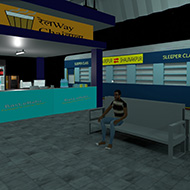
| Setting | Fakripur railway station |
| Protagonist | Ramu, a railway chaiwala |
| Core Loop | Brew chai, prepare food, serve passengers, uncover the station’s secrets |
| Perspective | First-person |
You play as Ramu, running a small stall at the edge of a busy railway platform. Every shift starts the same way: crack the gas valve under the stall, wait for the flame to catch, and get the first pan of milk heating while trains rumble somewhere down the line. There’s no menu screen dumping lore on you — you’re just working, and the game trusts that to be interesting on its own for a while.
It mostly is. The rhythm of serving passengers, timing the chai, and keeping the stall running has a genuine cozy-management pull to it early on.
The core loop rotates around three tasks: brewing chai to order, frying samosas without burning a batch, and handing out bottles of Kokila Cola to travelers who don’t want to wait. None of these tasks are individually hard, but doing all three while a queue builds during a train arrival is where the actual pressure of the game shows up.
Players who treat this purely as a cooking sim tend to breeze through the first sessions, only to be caught off guard when the station’s rhythm starts shifting under them.
Simulation fans in particular tend to praise how tactile the brewing and frying feel, even before anything strange starts happening around Ramu’s stall.
Kokila Cola shows up constantly as background flavor — bottles stacked on the counter, passengers asking for it by name — and it’s one of those small branded details players end up referencing in reviews because it makes Fakripur station feel like a real place instead of a generic backdrop.
Early in the game, everything reads as a straightforward day-in-the-life sim. By the time you’ve handled a few full shifts at the stall, small inconsistencies start creeping into the environment — a passenger who repeats a line they already said, an announcement for a train that isn’t on the platform. Railway Chai Wala never announces the tonal shift with a jump scare; it just lets the wrongness accumulate.
That slow-burn pacing is one of the things players call out most in discussions of the game.
Daytime shifts at the stall play almost entirely as a service sim: keep up with orders, don’t burn the samosas, keep Ramu’s till full. Once the game shifts you into later shifts, the same station starts feeling thinner and quieter, and the horror-adjacent elements the psychological thriller framing hints at start surfacing more directly.
Regulars at the stall behave consistently enough that experienced players start recognizing which passenger requests are just flavor text and which ones are worth paying closer attention to, since Railway Chai Wala tends to bury small narrative hints inside otherwise ordinary customer interactions.
Without spoiling specifics, the mystery underneath the daily grind of serving chai ties back to Fakripur station itself and what’s happened there before Ramu ever set up his stall. Story-focused players tend to rate this thread as the strongest part of the game, since it reframes the earlier cooking-sim hours once you understand what they were building toward.
Not everyone loves how long Railway Chai Wala stays in cozy-simulation mode before the thriller elements take over. Some players find the slow build genuinely effective; others wanted the unsettling parts to arrive sooner and feel the early shifts run a little long by comparison. It’s a fair criticism, and one the game’s own community discussions bring up regularly.
Players commonly refer to the “quiet shifts” when describing the sections where nothing narrative happens, and use “the loop” to describe the brew-fry-serve cycle that repeats each shift. On Steam, user reviews for the game have landed heavily positive, with the vast majority of the roughly five dozen reviews rating it favorably — a solid signal for a title this specific in tone.
Railway Chai Wala earns its reputation less from any single mechanic and more from how patiently it lets Fakripur station turn strange around Ramu, one shift and one bottle of Kokila Cola at a time.