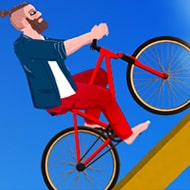
Short Ride looks like a goofy bike toy but plays like a lesson in patience, because one twitchy tap on the accelerator is the difference between clearing a spinning saw blade and watching your rider lose a limb mid-jump.
| Genre |
Physics-based obstacle course |
| Platform |
Browser, desktop and mobile |
| Core Loop |
Ride through hazard-filled courses, collect stars, reach the finish |
| Vehicles |
Bike, pogo stick, shopping trolley, segway |
| Levels |
Around 20 hazard courses |
Vehicles and Control in Short Ride
You steer with the arrow keys or WASD, accelerate to build speed, and use the spacebar to hop on or off your ride mid-course. Balance matters as much as speed — leaning too far forward on a bike sends your rider face-first into a spike before you’ve even reached the obstacle that was supposed to be the real threat. The physics engine reacts to momentum rather than a fixed animation, so the same jump can end cleanly or catastrophically depending on how much speed you were carrying into it.
Beyond the standard bike, Short Ride hands you a pogo stick, a shopping trolley, and a segway, and each one changes how a course actually plays. The trolley in particular rewards a completely different rhythm than the bike, since its wider base survives clips that would send a bike rider tumbling, but its clumsy turning makes tight corners far riskier. The pogo stick strips out horizontal speed almost entirely and turns every course into a timing puzzle, since you’re bouncing over hazards rather than riding past them, which forces a slower, more deliberate read of each obstacle cluster.
Players used to the studio’s earlier obstacle title tend to adapt fast, since the ragdoll feel carries over almost directly, but the added vehicle variety in Short Ride means old muscle memory only carries you through the bike sections. Once a course forces a segway switch partway through, that transferred instinct stops being reliable, and you’re relearning acceleration and braking from scratch mid-run.
Hazards That Define Each Level
Every course leans on the same core hazard set — spinning saws, spike beds, and timed bombs — but the arrangement changes enough level to level that memorization only gets you so far. Once you reach the later courses, hazards start chaining together, so clearing one saw blade with no margin left often means riding straight into the next trap. A bomb placed right after a spike bed, for instance, punishes players who slow down out of caution just as much as it punishes players who barrel through carelessly.
The ammo box equivalent here is really the star: three stars sit in each level, and collecting all of them usually means taking a riskier line than the safest possible route through the hazards. Grabbing a star tucked above a saw blade, for example, often means sacrificing the clean landing you’d get by skipping it, which is exactly the tradeoff the level design leans on.
Completionists chase all three stars on every course, treating a clean run without full stars as unfinished business, while players who just want to see the ending tend to ignore stars entirely and beeline for the finish flag. By the time you reach the courses built around the shopping trolley, that split becomes even more obvious, since star placement on wider vehicles frequently sits in spots a bike could never reach safely in the first place.
Ragdoll Physics and Why Restarting Matters
The ragdoll system is where most of the game’s dark humor lives — mistimed jumps end in exaggerated, limb-flailing wipeouts rather than a quiet fade to a game-over screen. Watching your rider cartwheel off a saw blade in slow motion is as much a part of the appeal as actually finishing a course, and it’s a big reason players screen-record their worst runs to share rather than hide them.
The R key restarts a level instantly, and leaning on it constantly is less a failure state and more how the game expects you to play, especially once bombs start appearing alongside spikes. Players in community discussions often call this “rider-cycling” — dying on purpose early in a course just to relearn the timing of one specific hazard before committing to a full clean run.
This instant-restart rhythm is what keeps Short Ride from feeling punishing in the way a game with long respawn waits would. A death costs you a second or two, not a lost run, so even the courses built around the pogo stick — where timing margins shrink dramatically — stay approachable rather than frustrating for players willing to eat a few wipeouts.
Star Collection and the Level Editor in Short Ride
Beyond the built-in 20 courses, Short Ride includes a level editor that lets players build and share their own hazard layouts, which is a big part of why the game has stuck around in browser-game communities well past its original run of official levels. Custom courses tend to lean harder into bomb chains and tight saw-blade corridors than the base game does, since community builders are usually designing for players who already have the core mechanics down.
Casual players mostly ignore the editor, but it’s clearly aimed at the segment of the player base that treats star-collecting and route optimization as the actual endgame. For that group, the appeal isn’t finishing the 20 official courses once — it’s building a personal best time on a course, then trying to beat it on a harder vehicle like the pogo stick once the bike run feels solved.
Not everyone loves the difficulty curve, though — some players feel the jump between early and late courses is steeper than it needs to be, and that a few hazard placements rely more on trial-and-error memorization than genuine skill. It’s a fair complaint given how punishing a single mistimed jump can be this late into a run, and it’s the most common criticism you’ll find in reviews of Short Ride once players get past the first handful of levels.
What actually happens once you’ve cracked open the editor and built a course meaner than anything the original 20 levels threw at you? That’s usually the point where Short Ride stops being a quick distraction and turns into the kind of game you keep one tab open for, one more star, one more shopping trolley run, one more wipeout off the pogo stick.