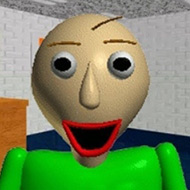
You solve the second problem on Baldi’s notebook wrong, and the ruler comes out before you’ve even processed what happened — a single wrong answer doesn’t end the run, but it starts a countdown you can feel in the way his footsteps change pace down the hall behind you.
Why Subter Baldi Punishes Math, Not Movement
The core loop is deceptively simple: find and solve seven notebooks scattered around a school built like a maze of near-identical hallways, then get to the exit. The math itself is trivial — basic arithmetic a real schoolboy would breeze through — but that’s not the actual test. Every wrong answer speeds Baldi up permanently for the rest of the run, and there’s no way to undo that once it happens. The game isn’t really about math at all; it’s about whether you can stay accurate under mounting pressure once the halls start feeling smaller.
Baldi himself doesn’t patrol randomly forever. He tracks toward notebook locations and known player activity, which means the same open notebook that’s helping you is also quietly working against you by giving him a reason to head your way.
Items That Actually Matter in Subter Baldi
- Jump Rope — a short, one-time speed boost used to put real distance between you and Baldi in a straight hallway
- Zesty Bar — restores a chunk of stamina, which matters more than it sounds once Baldi’s speed has ramped up several times
- Scissors — cuts through certain in-game elements blocking a shortcut route
- Bsoda — a temporary boost that can also be used defensively against certain other characters roaming the school
Knowing which item to grab first, rather than grabbing whatever’s closest, is one of the clearest signs of a player who’s actually learned the school’s layout instead of just reacting to it.
The Other Faculty Members Aren’t Just Set Dressing
Baldi isn’t the only thing roaming the halls. Playtime shows up with a jump rope of her own and forces a mini-game detour if she catches you, costing precious seconds you don’t get back. The Principal of the Thing enforces arbitrary rule violations — running in the halls, mostly — and will send you to detention if he catches you breaking them, which stalls your run at the worst possible moment. It’s a Bully will straight-up steal an item out of your inventory if you let them get close enough, which stings badly if it’s your jump rope right when you needed it.
None of these characters are optional obstacles you can just avoid indefinitely — they’re woven into the same halls you need to search, so avoiding one often means walking closer to another.
How Difficulty Actually Escalates
Early in the game, with zero notebooks solved, Baldi is slow enough that a wrong answer barely matters. By the time you reach the fourth or fifth notebook, his speed has compounded to the point where a single mistake in an exposed hallway can end the run outright. The escalation isn’t scripted by a timer — it’s a direct, permanent consequence of your own accuracy, which is why experienced players will sometimes back away from a notebook they’re not confident about rather than risk the speed penalty.
This is the detail new players consistently underestimate: the game never resets Baldi’s speed mid-run. There’s no cooldown, no forgiveness. Every wrong answer is permanent for that attempt, which turns the back half of a run into a completely different, much tenser game than the first couple of minutes suggested.
What Beginners Get Wrong Early On
New players tend to rush notebook collection without mapping the school first, which leads to backtracking through hallways Baldi’s already primed to patrol. The smarter approach — one veteran players bring up constantly — is spending the first minute or two just learning exits and shortcuts before searching seriously, since that knowledge pays off far more once Baldi’s speed climbs.
The other common mistake is panicking on a math problem instead of just taking the extra second to actually read it. A rushed wrong answer is strictly worse than a slow correct one, and the speed penalty makes that trade-off obvious in hindsight almost every time someone learns it the hard way.
The Ending Split Players Still Argue About
Reaching the exit door after all seven notebooks feels like a clean win, but players consistently debate whether the escalating-speed formula is genuinely fair or just an artificial difficulty spike dressed up as a math game. Some love that a single early mistake can define an entire run; others find it frustrating that recovery from a bad start is functionally impossible once Baldi’s speed has ramped up too far.
Can Baldi actually be avoided entirely?
Not for a full run — you have to search areas he can reach to find all seven notebooks, so total avoidance isn’t realistic beyond short-term dodging.
Does answering fast instead of accurately help?
No — rushing increases the odds of a wrong answer, and each wrong answer permanently speeds Baldi up for the rest of that attempt, so speed without accuracy backfires quickly.
Are Playtime and the Principal avoidable?
Mostly, with careful pathing, but both patrol common routes near notebook locations, so a full run without ever encountering them is uncommon.
Baldi’s Basics sells itself on a joke — a friendly-looking math teacher named Baldi — but what actually keeps players coming back is how cleanly that joke turns into real tension once the first wrong answer sets his speed climbing, with nothing left but a stolen jump rope and a long hallway between you and the exit.