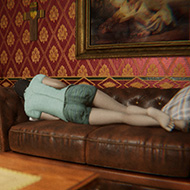
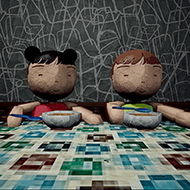
What actually happened to the missing boy Anton is supposed to be looking for, and why does everyone in the village seem to already know more about it than they’re saying? That’s the question Tiny Bunny keeps dangling in front of you, and it rarely gives a straight answer when you’d expect one.
| Genre |
Non-linear horror visual novel |
| Setting |
A remote taiga village, late 1990s Russia |
| Protagonist |
Anton, a schoolboy new to the village |
| Structure |
Branching paths, multiple endings |
Why Anton’s Arrival Sets Tiny Bunny’s Whole Tone
Anton and his family move to a remote taiga village because of his father’s history with local thugs — not exactly a fresh start, more a retreat. He’s not particularly welcome at his new school, except for one classmate, Polina, who ends up one of the few steady presences in a story that keeps pulling the ground out from under him. Meanwhile children have been disappearing from the village for years, and Anton gets pulled into trying to help find one of them, partly for a reward, partly to fund a promise he’s made to his sister Olya about a trip to Disneyland.
That domestic detail matters more than it sounds. Tiny Bunny keeps its horror grounded in ordinary family stakes — a sister’s disappointment, a father’s reputation, a promise made half out of guilt — which is part of why the escalating strangeness around the village lands as hard as it does.
The Masked Children Nobody in the Village Explains
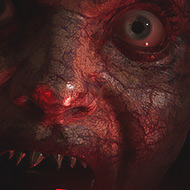
Alisa, who wears a fox mask, is the first of the masked children Anton encounters, and her presence tips the story from unsettling small-town mystery into something closer to full folk horror. She’s joined, across the story’s branches, by Teddy the bear, Hooty the owl, and Wolfy the wolf — a set of masked figures who clearly know something about the missing children that the adults in the story either don’t know or won’t say.
- Alisa (fox mask) — the first and most recurring of the masked children Anton meets
- Teddy (bear mask) — appears across later branches with his own unresolved motives
- Hooty (owl mask) — tied to some of the story’s more unsettling nighttime sequences
- Wolfy (wolf mask) — the least explained of the four, which players debate constantly
None of them are framed as simple villains. That ambiguity — are they threats, victims, or something in between — is exactly what keeps community theory threads active long after a first playthrough ends.
How the Village Itself Turns Against You
Early in the game, the horror is mostly suggestion — a creepy owl that frightens Olya, a pack of dancing animal figures that seem aware they’re being watched. Once Anton starts actively investigating the disappearances, the atmosphere shifts from unsettling to openly hostile, and the branching structure means a choice made in one scene can close off entire explanations later, without ever telling you what you missed.
This non-linear structure is one of the most-discussed aspects of Tiny Bunny in player communities. Because certain scenes only unlock based on earlier decisions, two players comparing notes on the same episode can end up describing almost entirely different experiences of what happened to the missing children.
What Beginners Get Wrong Going Into Tiny Bunny
Players expecting a linear, jump-scare-driven horror story tend to be thrown off by how much of Tiny Bunny’s tension comes from dialogue and implication rather than direct threat. Rushing through choices to “get to the scary part” tends to backfire — the branching paths reward players who sit with ambiguous scenes rather than clicking past them.
The other common mistake is assuming Polina and Olya are safe, static characters. Neither is guaranteed to stay unaffected by the story’s events depending on choices made, which surprises players expecting typical visual-novel safety for supporting cast.
Where Players Still Disagree
The ending structure is the most divisive part of the whole experience. Some players find the deliberately unresolved threads around the masked children thematically appropriate for a story about a village that clearly doesn’t want its secrets found; others find the lack of a clean explanation genuinely frustrating after multiple long playthroughs invested in figuring out exactly what Alisa and the others are.
- Is Tiny Bunny based on a real book? Yes — it’s adapted from a novel of the same name by Dmitriy Mordas, and the game expands on that source material across multiple branching episodes.
- Do you need to replay to see different endings? Yes — key decisions early in each episode lock out entire later scenes, so a single playthrough won’t reveal everything the story has to say about the missing children.
- Is Wolfy ever explained? Not fully — Wolfy remains one of the least resolved masked figures across the released episodes, which is a frequent topic in player theory discussions.
Tiny Bunny never quite tells you what Alisa’s fox mask is hiding, and by the time Anton’s search for the missing boy circles back to his own family’s reasons for being in the village at all, you realize that was probably the story it was telling the whole time.